Happy New Year !

Merry Christmass....

Monday, December 5, 2016

Trump attacks China on trade but misses the mark

President-elect Donald Trump has revived some of his China-bashing from the campaign trail -- but the misleading claims still puzzle economists.

Trump accused China late Sunday of gaining an unfair advantage over American companies by devaluing its currency and slapping heavy taxes on U.S. products. The attack via Twitter came after a controversial phone call with Taiwan's president on Friday that had already ruffled feathers in Beijing.
Blasting China over its currency, the yuan, was a recurring theme of Trump's presidential campaign as he appealed to voters disillusioned with the effects of globalization. He labeled Beijing "a big abuser," arguing it has given Chinese exports a boost -- and cost America jobs -- by keeping the yuan artificially low.
Economists say that was probably true in the past, but China is now battling to stop its currency from falling too much.

Did China ask us if it was OK to devalue their currency (making it hard for our companies to compete), heavily tax our products going into..

their country (the U.S. doesn't tax them) or to build a massive military complex in the middle of the South China Sea? I don't think so!
Beijing has been trying to give markets a greater role in determining the value of its currency. Between mid-2005 and early 2014, the yuan rose about 30% against the dollar. But as the Chinese economy has slowed in recent years, the yuan has fallen back.
"The irony of it is they're actually giving the market more say, but the market wants it to be weaker," said Julian Evans-Pritchard, a China expert at Capital Economics.
Chinese leaders want to avoid a repeat of the sharp drops that freaked out investors in August 2015 and January 2016. Beijing has burned through hundreds of billions of dollars since last year in efforts to prop up the yuan as huge sums of money have flowed out of the country.
Its foreign currency war chest, while still substantial, has dwindled to its lowest level in five years.
Trump attacking China for manipulating the yuan is unlikely to improve matters, economists say.
"I think in practical terms, it wouldn't do his voters any favors if he does actually try to get China to stop intervening in its currency," Evans-Pritchard said. "If anything, it's just going to make its exports cheaper because the currency will start falling even faster."
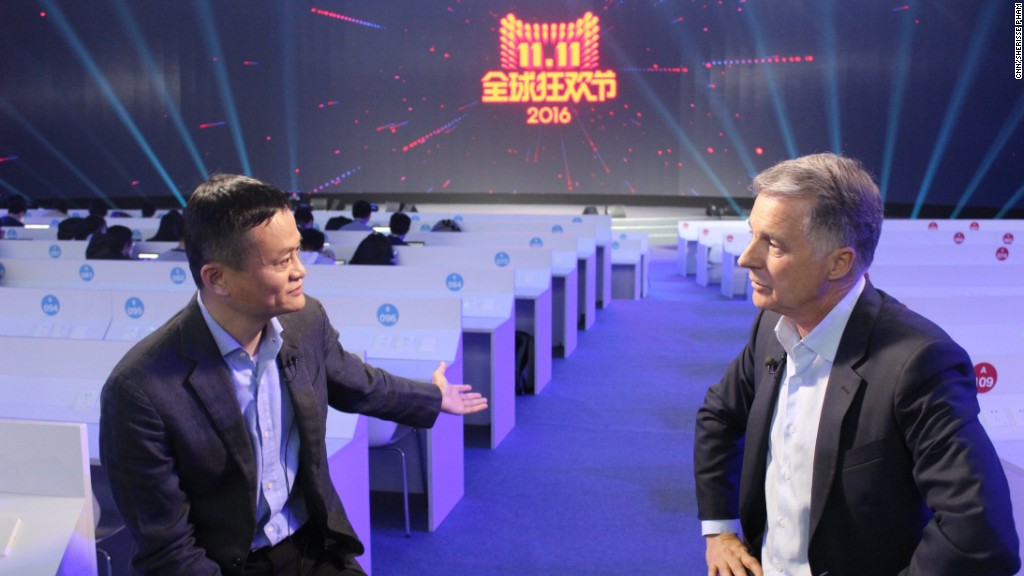
Jack Ma: President Trump must work with China
Trump's victory has also helped push the yuan to its lowest levels in about eight years. The U.S. dollar has surged against other currencies on expectations of a rate hike by the U.S. Federal Reserve this month and the potential for higher growth and inflation under Trump policies.
And since the U.S. election, the yuan has actually fallen less sharply against the dollar than many other emerging market currencies. And it has strengthened against the currencies of other major trading partners, like the euro and the Japanese yen.
During his campaign, Trump said he would label China a "currency manipulator," which would require the U.S. Treasury Secretary to hold talks with Beijing on the issue.
"I think it's just a good way for Trump to show he's being tough on China -- the symbolism is important -- without doing anything that would affect the trade relationship," Evans-Pritchard said. "It's an easy win."
Of much greater concern is Trump's threat to slap tariffs of as much as 45% on Chinese goods. If he follows through with that, the result could be a trade war that damages both economies.
The yuan wasn't Trump's only beef on Sunday. He also claimed that Beijing "heavily" taxes U.S. products but that the U.S. doesn't tax Chinese goods.
Economists say it's unclear what he meant. A spokeswoman for Trump didn't respond to a request for more information late Sunday.
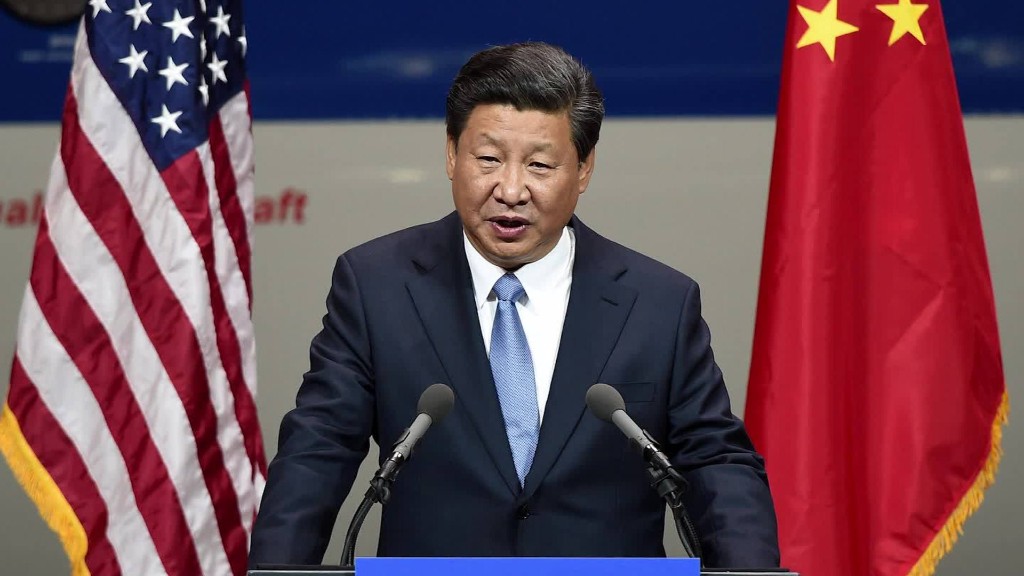
How will Trump deal with China?
In March, fact-checking website Politifact looked into similar comments Trump made to The New York Times about a "tremendous tax" imposed by China. It rated the claim "mostly false."
Trump might be referring to the sales tax that China and many other countries charge but the U.S. doesn't. That tax isn't specific to U.S. products, though. It applies to all goods, whether they're made in China or overseas.
Another possibility is that Trump is talking about import tariffs, which are generally higher in China than in the U.S. But the U.S. nonetheless imposes some degree of charges on goods from Chinese companies.
"It seems to me a lot of the issues he's focusing on now are either outdated or don't hold true," said Evans-Pritchard.
"Maybe he should focus on other grievances," he said, like China's restrictions on foreign investment or subsidies for state-run companies.

Meet Italy's Donald Trump

(CNN)Now it's Italy's turn for uncertainty.
By a large margin, Italian voters rejected a constitutional referendum on the reform of the parliamentary system that Prime Minister Matteo Renzi, of the center-left Democratic Party, had staked his reputation on.
    It's a huge victory for the Five Star Movement founded by comedian turned populist politician Beppe Grillo, who compares himself to Donald Trump and has shown a similar genius for marketing -- in this case through his blog.
    As happened with the outcomes of the Brexit vote in Great Britain and the Presidential election in the United States, this "No" vote carried with it an element of protest quite beyond the complicated political system reforms at hand.

    Italy's uncertain future

    What does this outcome mean for Italy, and how does this vote add to the trending illiberalism within Europe?
    Renzi had vowed to resign if a "No" vote prevailed, turning the referendum into a plebiscite about his leadership, which grew increasingly unpopular due to the ailing economy.
    Now it's very likely that Italy will hold elections that could result in what was previously unthinkable: the anti-establishment, and anti-European Union Five Star Movement at the pinnacle of the state, and more power for the right-wing Northern League party as well.
    The reforms proposed by the 41-year-old Renzi aimed to streamline Italy's government, which is surpassed only by Greece on most indexes of inefficiency.
    He envisioned (among other things) reducing the size and power of the Italian Senate (right now both House and Senate have equal approval rights on legislation), and a greater centralization of the energy, transportation, and infrastructure sectors.
    Renzi's critics, which include many Italians on the left, saw the reform as a power play that would remove checks and balances crucial to a healthy democracy.
    Many of the particularities of Italy's political system (such as decentralization) date from a 1948 Constitution written in the aftermath of two decades of rule by Benito Mussolini and designed to prevent the return of dictatorship. It would be a true irony if the vote against changing this anti-Fascist Constitution ushered in a new period of rightist politics in Italy.
    Related: Italians vote 'no,' a win for Eurosceptics 01:01
    At the moment, how a Five Star government would look and act is far from clear.
    Founded in 2009, it became a political force to contend with when it received more than 25% in the 2013 elections. Yet its platform is still so eclectic that it's been called "post-ideological." It draws in large numbers of young people for its support of web-based democracy, the environment, and sustainable development, and its harsh critiques of globalization and big business.
    Yet the Five Star Movement certainly does not map onto progressive politics as traditionally defined. Five Star members are economic protectionists, partial to conspiracy theories, and take a hard line against Islam and immigration.
    Grillo's corrosive comedy has included a "joke" that Sadiq Khan, London's Muslim mayor, might "blow himself up in Westminster."
    And while the party's mantra is direct democracy, Grillo has a rather dictatorial personality. Perhaps that's why he adds his name to the many European politicians who admire Vladimir Putin (the Italian newspaper La Stampa reported that Russian sites were spreading fake news designed to help Grillo).

    source: edition.cnn.com

    Tuesday, November 15, 2016

    Gareth Bale - Best Fights & Angry Moments


    Gareth Bale - Best Fights & Angry Moments

    - "He nods, he gives me a condom, pod favod"


    He goes to a store and says to the salesman:
     - "He nods, he gives me a condom, pod favod"
    The seller can not believe what he hears and asks:


    - "Sorry ... what did you ask for?"
    - "A condoncito, pod favod ..."
     The astonished man says:
    - "IPero, why do you want a condon?"
    And the little boy: - "Pada ataadme ed zapatito .."

    Tuesday, November 1, 2016

    Donald Trump President From USA.


    Donald Trump President
    From USA.


    I did not feel so sad
    In the world since all
    Neighborhood
    To the Chavo of 8.

    9 of November of 1989


    9 of November of 1989:
    falls the wall of Berlin
    27 years later,
    November 9, 2016:


    They elect a president who
     wants to erect a wall.

    What do you study?


    - What do you study?
    - Degree in distinguishing koalas
    - How is that? - See that dog?


    Yes. - Well, it's not a koala.